
PSG edge Bayern 5-4 in nine-goal Champions League semi-final first leg
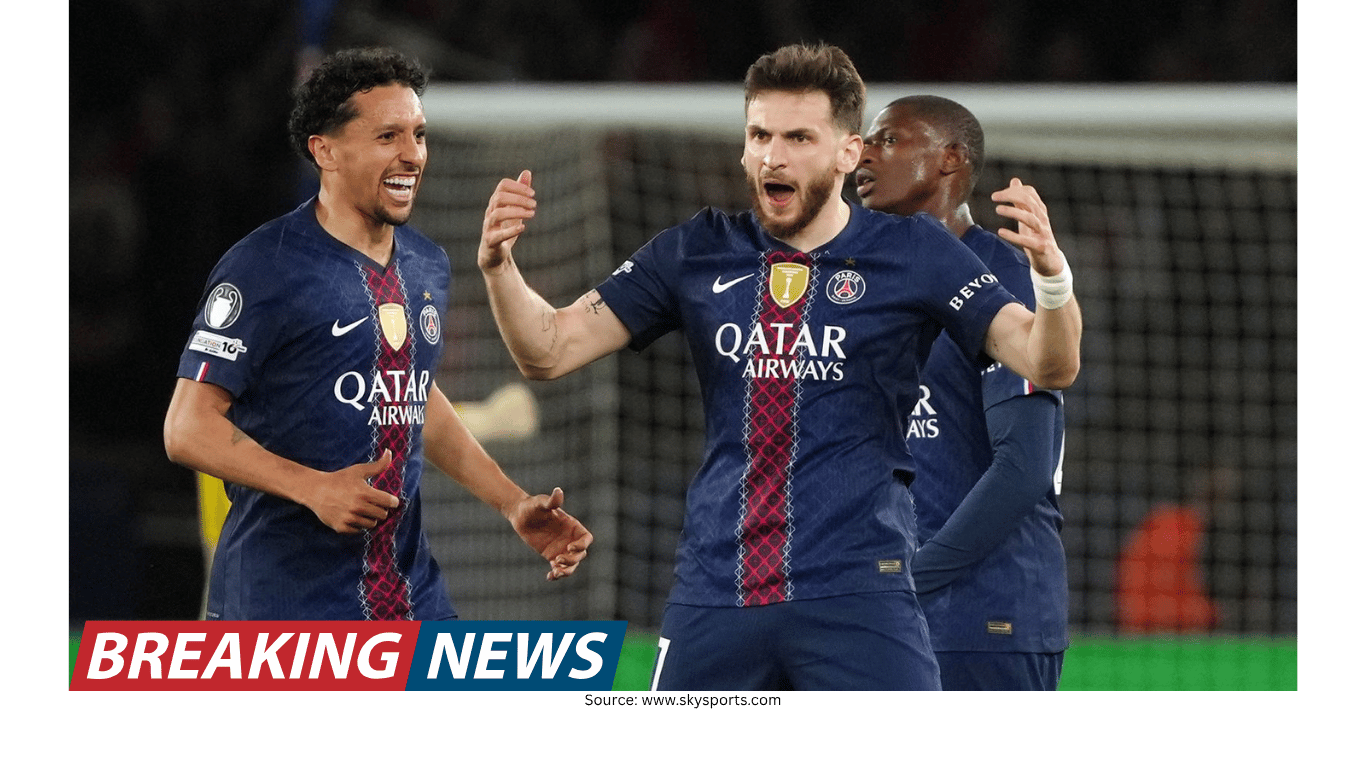
A semi-final for the ages as PSG take a one-goal lead to Germany
Paris Saint-Germain and Bayern Munich produced a Champions League spectacle that will be talked about for years, as the holders PSG won a breathless first leg 5-4 in Paris. Nine goals, multiple momentum swings and a late Bayern surge ensured the semi-final remains wide open ahead of next week’s return match in Germany.
The match carried historical weight as well as immediate drama. It was the first time in a European semi-final that both teams scored four or more goals, and it matched the joint-highest scoring semi-final in European Cup history, alongside Rangers’ 6-3 defeat to Eintracht Frankfurt in 1960. Even by modern Champions League standards, this was extreme.
For PSG, the headline was a pair of double-scorers: Ousmane Dembele and Khvicha Kvaratskhelia each struck twice in a first European semi-final that became a showcase of attacking ambition. For Bayern, the sting was obvious: they scored four times away from home and still lost, leaving them to chase the tie in front of their own supporters.
Five goals before the break set the tone
The contest began with Bayern striking first. Harry Kane opened the scoring in the 17th minute from the penalty spot, a goal that was noted as his 59th for club and country this season. It was an early statement in a match that quickly turned into a relentless exchange of chances and finishes.
PSG’s response was immediate and emphatic. Kvaratskhelia levelled with a superb equaliser, before Joao Neves headed the hosts into the lead in the 33rd minute. The pattern of the night was already clear: neither side was content to manage the game, and both looked to attack with numbers and speed.
Bayern hit back again when Michael Olise smashed in an equaliser in the 41st minute, restoring parity at 2-2. Yet the first half still had one more twist. In the fifth minute of added time, PSG regained the advantage through Dembele, who converted a penalty after a VAR review at the pitchside monitor.
The decision itself became a talking point. The penalty was awarded for an Alphonso Davies handball, even though Dembele’s cross struck Davies’ leg before making contact with his arm. It was a controversial moment in a match that had no shortage of incident, and it meant PSG went into the interval 3-2 up after a remarkable five-goal first half.
PSG surge after the restart — then Bayern roar back
Early in the second half, PSG looked capable of turning a thrilling tie into something close to decisive. Kvaratskhelia swept home to extend the lead, and then Dembele added another with a lovely finish in off the post. The two goals came in the space of 143 seconds, and by the 58th minute PSG were 5-2 ahead.
At that stage, the match appeared to be slipping away from Bayern, despite their ability to score. But the visitors refused to accept the script. Dayot Upamecano’s 65th-minute header started a rapid fightback, and three minutes later Luis Diaz produced a moment of quality to make it 5-4.
Diaz’s goal had its own VAR storyline. Initially ruled out for offside, it was eventually given after a check overturned the decision. The finish itself was expertly executed: Diaz brought down Kane’s lobbed pass and fired past PSG goalkeeper Matvey Safonov. In the space of three minutes, Bayern had transformed the end of the match from damage limitation into renewed belief.
The final stages were played with the tension of a tie that has not been settled, rather than a one-off classic. PSG held on for the win, but Bayern’s late goals ensured the second leg will be approached with genuine hope rather than mere obligation.
Neuer’s unusual night and a record-setting scoreline
Among the many striking details was the note that Bayern goalkeeper Manuel Neuer failed to make a save across the match. In a game where both teams’ forwards repeatedly found the net, it underlined how clinical the finishing was and how quickly attacks turned into goals.
The 5-4 scoreline also placed the match in rare company historically. European Cup semi-finals are typically defined by caution and control, but this one became a reference point for the opposite: risk, open play and constant attacking intent. With both teams scoring four or more, it moved into a category of its own.
Dembele: PSG will not change their approach
Dembele, named man of the match, suggested the second leg could be similarly chaotic. Speaking after the game, he described the first leg as a contest between “two great teams who attack, who don't hesitate.”
He also acknowledged a drop in PSG’s control after building a 5-2 lead. “We're happy with the result, even though at 5-2 we stopped playing a bit towards the end,” he said.
Most notably, Dembele indicated PSG will not shift into a defensive mindset simply because they have a narrow advantage. “We're not going to change our philosophy. We're going to attack, and they're going to attack too. So I think it's going to be a great second match,” he added.
That stance matters because the tie remains finely balanced. A one-goal lead is significant, but it is also fragile against an opponent that has already shown it can score repeatedly in Paris.
What the second leg could mean for Champions League history
The return match in Germany now carries the possibility of another statistical landmark. It was noted that if five goals are scored at the Allianz Arena in the second leg, the semi-final will become the highest-scoring Champions League knockout tie in history.
That is not a prediction of what will happen, but it is a measure of just how extraordinary the first leg was. With nine goals already on the board, the threshold for a record-breaking tie is within reach, especially given how both teams approached the game in Paris.
Kane’s view: praise for defenders — and a sharp rebuttal
After a match that ended 5-4, the post-match debate naturally turned to whether the game was a celebration of attacking excellence or an indictment of defensive standards. Kane offered a perspective that surprised some viewers, praising the defending despite the scoreline.
“Even though there was nine goals scored, there was some amazing defending out there,” Kane said. He pointed to the difficulty of the job, describing defenders moving into midfield and wide areas and dealing with elite attackers. “It's a really hard job. I thought they were outstanding,” he added.
That assessment was immediately challenged. Wayne Rooney disagreed, suggesting Kane’s comments were influenced by loyalty to his team-mates and the need to lift confidence ahead of the second leg. Rooney’s view was blunt: “The defending from both teams was really bad.”
The contrast between those two interpretations captured the wider tension in how such matches are judged. A nine-goal semi-final can be read as an attacking masterclass, a defensive collapse, or a combination of both depending on what moments are emphasised.
Carragher: attacking quality made goals feel inevitable
Another analysis focused less on defensive errors and more on the level of attacking performance. Jamie Carragher argued that the game was defined by attackers consistently outperforming their direct opponents.
“Normally when I see a game like that I'll say 'the defending is not good enough' or 'it is not up to the standard of this level of football',” he said. “But what I would say is: Every attacking player on the pitch was an eight or nine out of 10. Every attacking player got the better of their counterpart.”
Carragher also suggested that, in his view, the goals were not primarily the result of goalkeeping mistakes or “something stupid defensively.” Instead, he felt they were “just great goals,” created by attacking play at a level that made them difficult to stop.
He framed the match as an antidote to complaints about overly cautious football. With so many teams criticised for playing not to lose, this semi-final first leg offered the opposite: “plenty of risk.” Whether that makes coaches uncomfortable or not, it made for a compelling spectacle.
Key moments that shaped the 5-4 narrative
- 17’: Kane penalty gives Bayern the lead, setting an early tempo.
- PSG response: Kvaratskhelia levels before Neves heads PSG in front.
- 41’: Olise equalises to make it 2-2 in a frantic first half.
- 45+5’: Dembele penalty after VAR review restores PSG’s advantage at half-time.
- Second-half burst: Kvaratskhelia and Dembele score within 143 seconds to move PSG 5-2 ahead.
- Bayern’s late push: Upamecano and Diaz score in three minutes, with Diaz’s goal awarded after VAR overturns an offside call.
A tie still alive, with attacking intent on both sides
PSG will travel to Germany with a narrow advantage and a clear message from Dembele that their approach will not change. Bayern, meanwhile, can point to the fact they created four goals in Paris and came within one of drawing level, even after falling three behind.
The first leg delivered a rare blend of drama and historical significance: record-setting numbers, VAR interventions at key moments, and a match narrative that swung sharply from Bayern’s early lead to PSG’s apparent control, and then back to Bayern’s late surge.
With the return leg still to come, the only certainty is that the tie has been set up for another intense night. PSG have the lead, Bayern have the belief, and the semi-final remains poised on the edge of something even bigger if the goals keep coming.