
Arsenal book Champions League final spot as belief grows under Mikel Arteta
A night that felt like a turning point
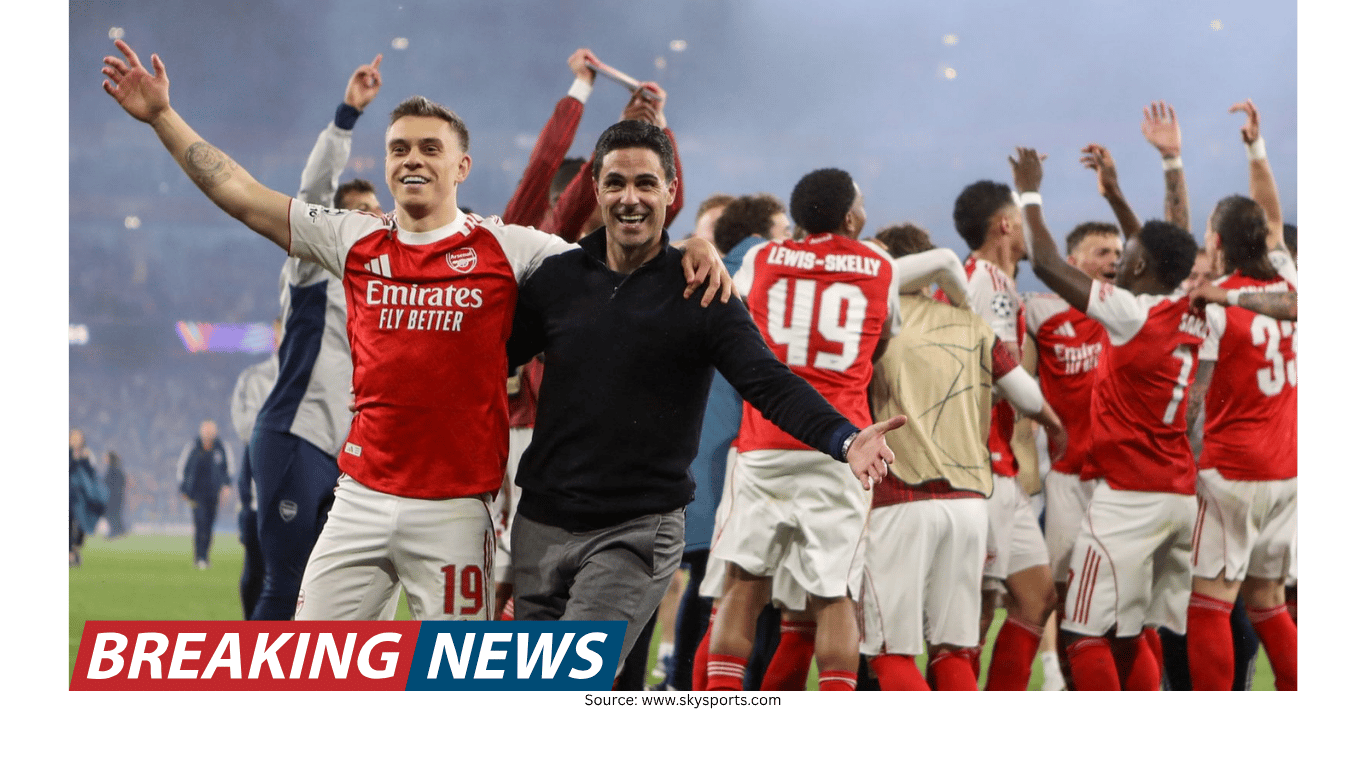
The final whistle brought a release that had been building for months. Arsenal are into the Champions League final for only the second time in their history, and the reaction inside the Emirates Stadium reflected the scale of the moment. The stands erupted, the pitch filled with players in a jubilant huddle, and Mikel Arteta ran on to join them.
Afterwards, Arteta tried to capture what the stadium had become in those final moments. “I’ve never felt that in a stadium before,” he said. For many supporters, the feeling was that they were watching a club step into a new phase—one where the pressure of big occasions is being met with something more constructive than anxiety.
That shift matters because it has not been a simple season of smooth progress. For long spells, Arsenal’s campaign has been accompanied by nervousness, the kind that can seep into a team’s rhythm and into the atmosphere around it. Yet on this semi-final night against Atletico Madrid, the energy inside the ground was different: louder, more unified, and more forgiving when the performance was not always fluent.
‘Over Land and Sea’: a message about mindset
Before kick-off, the teams emerged to a large tifo showing a fleet of boats alongside the words “Over Land and Sea.” It was not simply decoration. It was a nod back to Arteta’s comments in January after a defeat by Manchester United, when he urged everyone connected to the club to ignore the nerves and jump on the “fun boat” for the rest of the season.
At the time, it was an attempt to change the emotional temperature at the Emirates. Big moments had been accompanied by tension, and Arteta wanted a different kind of support—one that could carry the team through difficult periods rather than amplify the stress.
Against Atletico Madrid, that call appeared to have been answered. The stadium’s response was not dependent on perfection. Every tackle, header, and throw-in won was celebrated. Even when Arsenal were not entirely convincing, the crowd stayed with them. In a semi-final where control can be fleeting, that collective mindset became part of the performance.
A crucial 24 hours for Arsenal’s season
The semi-final victory arrived in the middle of a wider surge of positivity around the club. In the previous 24 hours, Arsenal were handed a boost in the Premier League title race when Manchester City dropped points, giving the initiative to Arteta’s side. Then came the Champions League breakthrough: the first final in a generation.
Arteta acknowledged the effect of those events when asked about the mood around the club. “Everybody can feel a shift in energy and a belief in everything,” he said, referring to the recent developments and urging that the feeling should be used “in the right way.”
It is a familiar message from a manager who often talks in terms of emotional control and collective direction. Arsenal’s challenge now is not simply to enjoy the moment, but to ensure the momentum becomes something practical—points in the league and composure in the biggest match of their European season.
Injuries easing at the right time
Momentum in football is rarely only about results. It is also about availability, rhythm, and the sense that a squad is becoming more complete rather than more depleted. Arsenal have received timely boosts on that front too, with key players returning or regaining form as the decisive weeks approach.
Bukayo Saka is the most obvious example. He has produced two goals and an assist in just over 100 minutes of action across the last few days, a burst of output that underlines his importance to Arsenal’s attacking threat.
Riccardo Calafiori has brought added steel to the defensive unit while also contributing creativity going forward. Myles Lewis-Skelly has provided freshness in midfield at a time when the team has looked short of energy in that area. Martin Odegaard’s return is another factor, and Kai Havertz is still expected to come back properly after missing recent matches.
Individually, each return offers a lift. Collectively, they change the feeling around the squad: not only stronger in numbers, but stronger in confidence. For a team chasing major honours, that sense of reinforcement can be as valuable as any tactical tweak.
Arteta’s ‘beasts’ demand and the details that decided the tie
Before the match, Arteta asked his players to be “beasts” against Atletico Madrid. It was a phrase aimed at intensity and resilience, and it was reflected in the kind of moments that define knockout football.
Declan Rice produced a goal-saving challenge in the first half. Gabriel made two crucial interventions in the second half to deny close-range efforts. These are not highlights designed for a season review montage in the way a long-range strike might be, but they are often the difference between reaching a final and watching one from home.
Leandro Trossard’s contribution was another example of the work that can go underappreciated. He made 10 ball recoveries—twice as many as the next best player on the pitch—while tracking back to limit Atletico’s threat through Antoine Griezmann. It was a performance rooted in discipline and concentration, the kind of role that can be essential against opponents who thrive on small openings.
Gyokeres’ relentless running and a crowd that stayed with him
Perhaps the clearest symbol of Arsenal’s renewed energy on the night was Viktor Gyokeres. The striker pressed Atletico’s defenders from start to finish, helping Arsenal move up the pitch and forcing the opposition into hurried decisions. His running also had a visible effect on the stadium: every burst seemed to lift the noise level, reinforcing the sense of a team and crowd feeding off one another.
One of those runs down the right wing led to the winning goal for Saka. It was similar to a move that had produced a goal against Fulham on Saturday, suggesting a pattern in Arsenal’s attacking play that is becoming more reliable at a critical stage of the season.
Gyokeres also missed a second-half chance, but the reaction from the stands was telling. Rather than turning anxious, supporters continued to back him. That is part of the broader theme of the evening: a club that has looked more comfortable living with imperfection, as long as the effort and structure remain intact.
Arteta was emphatic in his assessment. “He was immense,” he said. “You could see the reaction of the crowd every time he was holding the ball. His work rate, what he gave the team, was just incredible.” Wayne Rooney, watching the performance, highlighted the same qualities, describing Gyokeres as a striker who “does all the dirty work” and played “a massive role” in the win.
A team that looks more complete at the business end
At key points earlier in the campaign, Arsenal have been portrayed as a side with vulnerabilities—moments where the pressure of expectation could lead to costly mistakes, or where the absence of a dominant centre-forward might become decisive. On this evidence, those concerns are not defining them in the same way now.
In the semi-final second leg, Arsenal did not look like a team full of holes. They did not look like a side constantly on the edge of an error. Instead, they looked organised, committed, and increasingly comfortable in the kind of tight, high-stakes contest that can expose any weakness.
They may not carry the same “glitz and glamour” often associated with some of Europe’s most celebrated squads, but they are showing a steeliness that travels well in knockout football. That steeliness is also measurable. This was Arsenal’s 30th clean sheet of the season in all competitions, and across their European campaign they have conceded only seven goals in 14 matches.
Those numbers suggest a team built on defensive reliability, and that provides a platform for everything else. In the Champions League, where one lapse can end a campaign, the ability to shut games down becomes a form of control.
Budapest awaits, with a title race still in play
The immediate reward is a place in the final in Budapest on May 30. The broader opportunity is even bigger: Arsenal are also in a Premier League title race in which they now have the initiative. The question naturally follows—can this be a season that ends with two trophies?
Arteta’s answer was calm but confident. “We have the ability and the conviction to do that for sure,” he said when asked about turning this into a special season. The wording matters: ability is one thing, conviction another. In the past, Arsenal have at times looked like a team still learning how to carry expectation. Now, the manager is talking as if the group is ready to embrace it.
There is little time to dwell on the semi-final celebrations, however. Domestic commitments continue, with West Ham vs Arsenal scheduled for Sunday with a 4.30pm kick-off. The league run-in will demand the same emotional control Arteta referenced after the semi-final: using the energy in the right way, without letting it become a distraction.
What supporters are saying: optimism, perspective, and a call for maturity
Reaction among viewers captured a mix of excitement and realism. Some pointed to earlier setbacks as potentially useful in sharpening the team’s focus, while others highlighted the value of continuity under a coach who has been allowed time to build.
- One comment suggested that losing a domestic cup final to Manchester City could ultimately prove beneficial, arguing that the squad now needs a “winner’s mentality” and greater ruthlessness in taking chances.
- Another praised the decision to stick with a coach and allow a squad to develop, suggesting other clubs could learn from the approach.
- A further reaction singled out individual contributions—Gyokeres’ display, Rice and Gabriel’s defensive work, Lewis-Skelly’s maturity, and key moments from the goalkeeper—as evidence of a collective effort.
That blend of optimism and caution is appropriate. Arsenal have earned the right to dream, but the final weeks of the season will test whether this new atmosphere and renewed belief can be sustained under the heaviest pressure.
The momentum is real—now comes the hardest part
Arsenal’s achievement is clear: a Champions League final place secured, a stadium re-energised, and a squad beginning to look healthier at exactly the moment it needs to. The most striking aspect of the semi-final night was not only the result, but the sense of alignment—between manager, players, and supporters.
In recent weeks, the Emirates has sounded like a ground that expects good things rather than fears what might go wrong. On the pitch, Arsenal have shown the defensive consistency of a team that can handle elite opposition, and the work rate of a side ready to suffer when the game demands it.
Whether this ends with one trophy, two, or none will be decided in the matches still to come. But Arsenal have put themselves in position, and they have done it with a shift in energy that Arteta believes everyone can feel. In a season where margins will decide everything, that might be one of the biggest advantages they have.