
Fernández rescues managerless Chelsea with stoppage-time equaliser against Manchester City
Chelsea’s turbulent backdrop meets a high-stakes test
Manchester City approached the visit of Chelsea as a fixture that, on paper, might have looked well-timed. Chelsea’s league form had been poor in December, and the tensions around Enzo Maresca’s position culminated in a change on New Year’s Eve. By the time the calendar turned, Chelsea were managerless, and the responsibility for a major away match fell to Calum McFarlane, the club’s under-21 coach.
It was an unusually abrupt promotion. McFarlane had never taken charge of a senior game, yet he was thrust into one of the season’s marquee contests. Chelsea hoped to appoint a permanent successor quickly, with a derby at Fulham looming on Wednesday. Liam Rosenior, identified as the top target, travelled to London for final talks. Still, for at least one afternoon, Chelsea’s direction belonged to a rookie in the technical area, facing Pep Guardiola and a City side with title pressure mounting.
City control the middle as Chelsea dig in
Guardiola’s initial structure emphasised congestion in central areas. Tijjani Reijnders started on the left of a four-man midfield but was asked to tuck inside, while Nico O’Reilly pushed up from left-back to provide width. The effect was City overloading the centre of the pitch and attempting to wear down Chelsea’s resistance through sustained pressure and positional control.
Chelsea’s starting approach was more conservative and combative. Cole Palmer operated to the right of a three-man midfield, though he often became the most advanced of the trio. Chelsea began by digging in and trying to impose themselves physically, with captain Reece James prominent in a deeper midfield role. His intent appeared clear: compensate for the absence of the suspended Moisés Caicedo by ensuring Chelsea did not lack bite or intensity.
Despite the defensive posture, Chelsea showed they could threaten. In the 19th minute, Estêvão Willian had an opening after Pedro Neto pulled the ball back low from the left, but Josko Gvardiol blocked the shot. It was a reminder that City’s dominance would not necessarily translate into a comfortable afternoon.
Rodri’s return shapes the momentum as City strike first
As half-time approached, City stepped up the tempo, a phase that coincided with Rodri asserting himself. On his first league start in three months, he drove City forward and helped turn patient circulation into sharper, more purposeful attacks. Phil Foden had gone close earlier, but City looked increasingly unwilling to accept Chelsea’s resistance.
One sequence captured City’s growing threat: Rodri played forward, Foden flicked on, and Erling Haaland broke through. Haaland’s shot deflected off Trevoh Chalobah and forced Filip Jörgensen—playing in place of the injured Robert Sánchez—into a fine one-handed save. Soon after, Rodri again found Haaland, whose curling effort struck the inside of the far post after he darted inside.
City’s pressure eventually told. Chelsea could not reach the interval level. Rodri allowed Rayan Cherki to take over the ball in midfield, and when the pass went forward, Benoît Badiashile’s clearance was unconvincing. Reijnders nipped in, teased Badiashile, rolled his studs over the ball to go outside, and then lashed the finish high inside the near post. For Jörgensen, it was the kind of concession that rarely reflects well on a goalkeeper, but the power of the strike left little room for debate.
McFarlane’s substitutions shift the balance
With City leading, the match became a test of whether Chelsea could adapt under an interim coach in his first senior assignment. McFarlane responded with changes that improved Chelsea’s attacking shape and energy. Andrey Santos entered midfield, which helped free Enzo Fernández to influence play more directly. Palmer moved to the right wing, from where he continued to roam, and Malo Gusto switched from left-back to right-back with instructions to push forward.
The adjustments produced clearer chances. Fernández showed wonderful skill when he pirouetted after a Palmer pass and set up Neto, only for the winger to lift his effort wastefully over the crossbar. Chelsea were still behind, but they looked more capable of sustaining attacks and asking City questions.
City search for a second as Chelsea stay alive
City continued to press for a decisive second goal. Haaland was denied by a Badiashile block, while Bernardo Silva was similarly thwarted by Jorrel Hato, who had come on as a substitute. Yet Chelsea were never completely out of the contest, and their growing belief became increasingly evident as the match moved into its final stages.
McFarlane’s substitutions proved significant again, notably the introduction of former City striker Liam Delap. Chelsea were pushing, and Palmer almost found the moment to change the story in the 89th minute, but his side-footed effort lacked the contact he wanted. When the fourth official signalled six additional minutes, nerves spread among the home support.
Fernández’s persistence delivers a dramatic equaliser
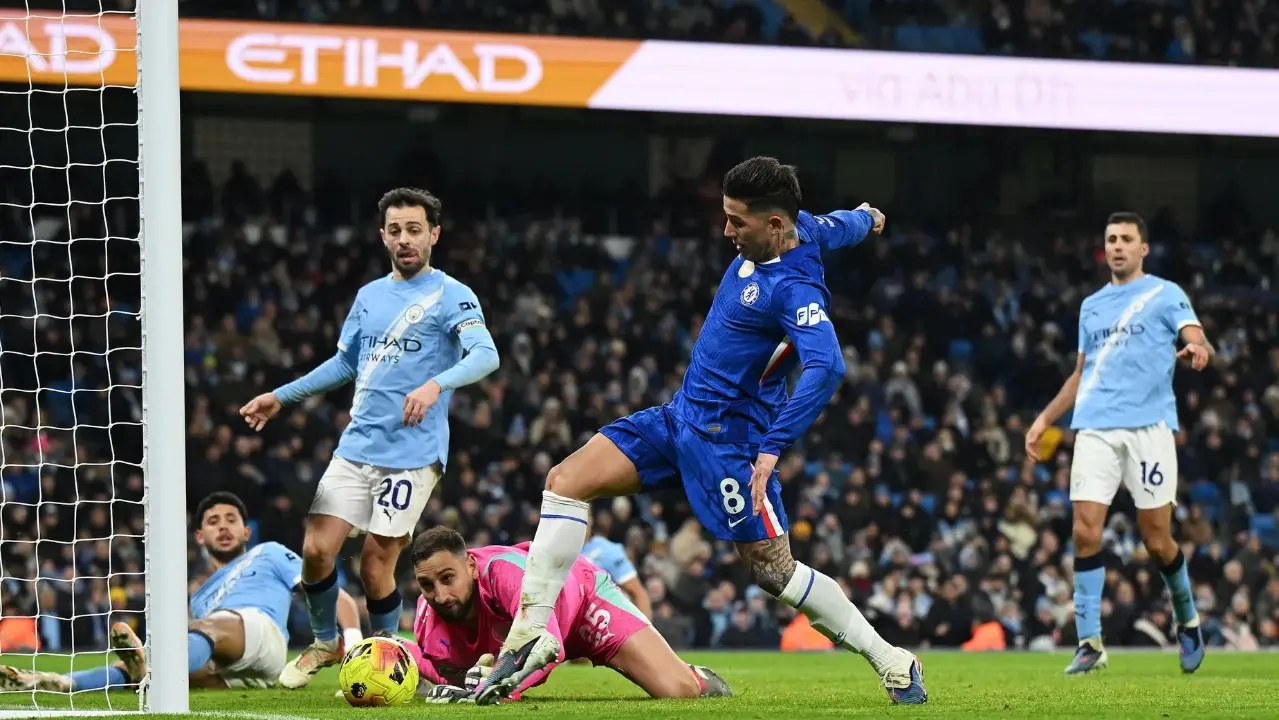
The equaliser, when it arrived, did not feel like a random twist. Chelsea had been building pressure, and the sequence reflected that. Gusto’s cross from the right took a slight deflection. Delap could not reach it in the middle, but Fernández arrived at the far post to keep the move alive.
It took persistence. Fernández’s first attempt was a mis-kicked swipe. His second effort drew a close-range save from Gianluigi Donnarumma. The third could not be missed, and Chelsea had their 1-1 draw. Fernández disappeared into the arms of the away supporters, while Guardiola reacted in visible frustration at what the moment meant for his side.
What the draw means for City’s title chase
For City, the late concession was a painful outcome in a season where margins are decisive. Guardiola had wanted a response to a recent draw at Sunderland and to the pressure created by Arsenal’s win at Bournemouth the day before. Instead, City failed to convert their control and chances into a two-goal cushion, and the dropped points left them six points adrift. It was described as a problem, even if not an insurmountable one.
Key takeaways from the match
- Chelsea’s interim coach Calum McFarlane oversaw a disciplined performance and made impactful substitutions.
- City’s midfield overload and Rodri’s influence helped them build sustained pressure and take the lead through Reijnders.
- Chelsea improved after changes, with Fernández more involved and Palmer operating wider.
- Fernández’s stoppage-time equaliser reflected Chelsea’s late push rather than an isolated moment.
- The draw left City six points behind in the title race, underlining how costly late concessions can be.