
Carragher analysis: How Manchester City’s midfield turned the tide against Arsenal
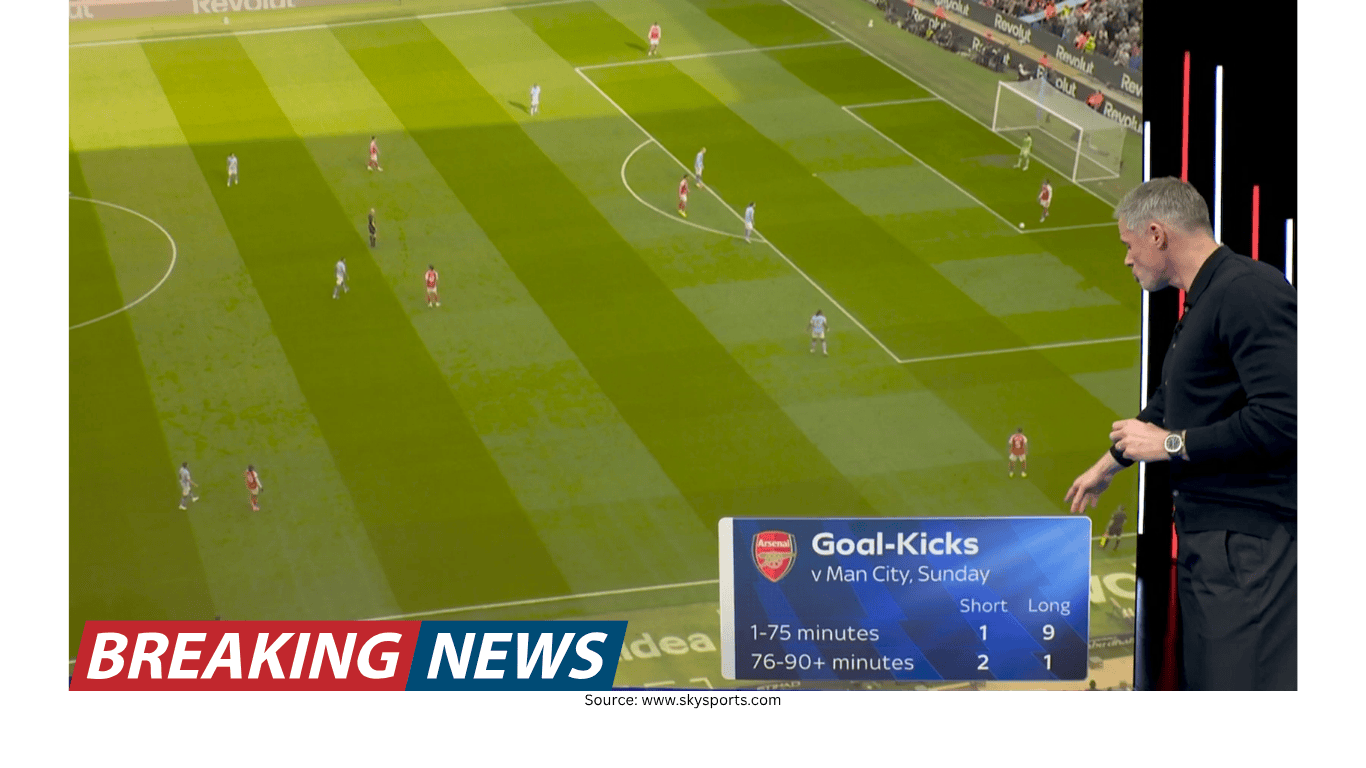
City’s 2-1 win reshapes the title picture
Manchester City’s 2-1 victory over Arsenal at the Etihad Stadium reopened the Premier League title race. The result left Pep Guardiola’s side three points behind Mikel Arteta’s leaders, with a game in hand, and set up what was described as a thrilling run-in to the end of the season.
In analysis delivered on Monday Night Football, Jamie Carragher framed the match as one ultimately decided by control of central areas. His conclusion was blunt: the game swung on who won the midfield battle. For Carragher, City’s experienced pairing of Rodri and Bernardo Silva did more than simply play well; they found solutions under pressure, adjusted their positioning, and repeatedly showed a willingness to take responsibility in the most uncomfortable moments of the game.
Carragher’s central claim: “The game was won in midfield”
Carragher’s headline assessment was that City’s midfield duo outperformed their Arsenal counterparts. He praised Rodri and Bernardo Silva in particularly strong terms, calling their display together “one of the greatest performances as a pair” he had seen in the Premier League.
In Carragher’s view, this was not only about passing quality or tactical discipline. It was about decision-making under pressure, the ability to recognise what the opponent is trying to do, and the courage to keep executing a plan even after early mistakes. City, he argued, were able to turn Arsenal’s initial strengths into a problem for the visitors.
Arsenal’s early press: a fast start that set the tone
Arsenal began the match with an effective press, and Carragher highlighted a specific statistic to underline how sharp it was. In the opening 15 minutes, Arsenal won possession in the final third six times, which was described as the most of any side in the Premier League this season.
That early pressure had a clear tactical purpose. Carragher explained that Declan Rice and Martin Odegaard were “coming right at” Rodri and Silva, restricting City’s ability to connect cleanly into midfield areas and forcing the first phase of build-up into uncomfortable territory.
At that stage, the match looked like it might be shaped by Arsenal’s ability to disrupt City’s rhythm. Carragher even pointed to an early moment where Bernardo Silva lost the ball under pressure from Rice, an example of the risk that comes with trying to play through an aggressive press.
The adjustment: Rodri and Silva drop deeper to change the picture
For Carragher, the key turning point was how City responded rather than how they started. He argued that Rodri and Silva showed bravery in possession by dropping deeper to receive the ball, even if it meant collecting it in areas that are typically the domain of defenders.
“Silva and Rodri ended up in the back four,” Carragher said, describing a pattern where they effectively became the centre-backs during build-up to ensure City could keep the ball and progress play. The message in his analysis was that City’s midfielders did not hide from the press; they moved toward it, took the ball anyway, and trusted themselves to play through it.
That willingness to keep demanding possession after an early error was, in Carragher’s telling, a defining trait. The fact Silva lost it once did not change the behaviour. “It didn’t stop them from getting it again,” he said, framing it as “real courage” to keep showing for the ball and keep trying to solve the same problem.
Carragher’s broader point was that City did not merely withstand Arsenal’s pressure. By altering their positions and continuing to receive the ball, Rodri and Silva forced Arsenal to adapt. As Carragher put it, City “seen a problem and gone and given Arsenal a problem.”
Playing out from the back: courage with the ball becomes the separator
A major theme of Carragher’s breakdown was the contrast between the teams when building from deep. He argued that City’s players showed courage “with and without the ball,” while Arsenal’s issues were most visible when they had possession and needed to play through pressure.
According to Carragher, Arsenal were unable to match City’s ingenuity when confronted by City’s four-man press. Rather than consistently playing through it, Arsenal often went long from goal kicks. Carragher challenged the idea that Arsenal were adventurous on the day, suggesting that much of their perceived boldness came out of possession rather than with it.
He also referenced a previous meeting, describing how Arsenal had already faced problems trying to play past City’s front four. In that earlier context, Carragher said Arsenal altered their setup from goal kicks, with a different positioning structure designed to bypass pressure. In this match, he argued, the plan again leaned toward going long rather than repeatedly engaging in risky short build-up.
“In your six-yard box”: Carragher’s emphasis on responsibility under pressure
Carragher’s most vivid description of City’s approach focused on where Rodri and Silva were willing to receive the ball. He highlighted sequences where they would drop into extremely deep areas, even into the six-yard box, to take possession from their goalkeeper and dribble or pass their way out.
He framed that as a rare kind of bravery, especially considering the magnitude of the game. “The courage to go and get the ball in your six-yard box off your goalkeeper in a game of this magnitude is absolutely outstanding,” Carragher said.
His argument was not that Arsenal lacked effort, but that there is a difference between pressing hard and taking the ball when the pressure is on you. “Sometimes players don’t really want the ball,” he said, presenting that as the “big difference” between the sides.
Carragher also pointed to a numerical advantage Arsenal could have used when playing out. He described a situation of “7 vs 4, including your goalkeeper,” and insisted that a team must be able to escape those moments with composure. In his view, City’s midfielders repeatedly volunteered themselves as solutions, while Arsenal did not consistently do so.
Arsenal’s options in build-up, and the contrast Carragher drew
In outlining Arsenal’s build-up possibilities, Carragher listed the types of outlets that were available: the ball could go to William Saliba, it could be chipped to Mosquera, and Martin Odegaard could drop deep, with Kai Havertz also present. Yet the thrust of his point was that having options is not the same as using them with conviction against elite pressure.
He contrasted that with City’s repeated pattern of Rodri and Silva stepping into those uncomfortable zones to take the ball. Where Arsenal sought to bypass pressure, City sought to solve it.
A key moment in the opener: the space that appears when one player can’t recover
Carragher also highlighted the role of Martin Zubimendi in the phase of play around Cherki’s solo goal that opened the scoring for City. His analysis focused on how small changes in defensive positioning can create decisive space.
In the same overall phase, Carragher said Zubimendi initially helped his defence by moving across to crowd out Cherki, shadowing him and filling the half spaces. At that moment, City’s attacker was surrounded by multiple defenders, and the situation looked contained.
But Carragher’s point was that the next action happened quickly. When the ball moved across again, Zubimendi could not get over in time to affect the next duel in a near identical situation. Carragher described how the picture changed from five players around the attacker to four, and argued that even a single missing defender can provide just enough room for a top player to act.
“That is still a very difficult proposition for any player in world football,” Carragher said of facing four defenders, “but with one player less, there’s slightly more space.” In his telling, Cherki found precisely the margin he needed.
The second goal build-up: a turnover and the importance of clean decisions
Another sequence Carragher focused on came in the build-up to City’s second goal. He said Zubimendi gave away possession with a forward ball that ran through to Gianluigi Donnarumma, allowing the goalkeeper to launch City into an attack.
Carragher used this moment to return to his central theme: courage and quality on the ball. He described Zubimendi as a European champion with Spain and framed his role as someone brought into the team to take the ball in difficult situations, particularly in high-stakes matches.
From Carragher’s perspective, the turnover was not merely a mistake; it was symbolic of the contrast between City’s midfielders and Arsenal’s. Where Rodri and Silva kept taking responsibility, Carragher argued Arsenal did not meet the same standard in possession at key moments.
Covering the right side: legs, positioning, and midfield balance
Carragher also discussed a later detail involving Zubimendi’s ability to cover across the pitch. He described a moment where Gabriel Martinelli jumped to press Marc Guehi as Donnarumma played the ball over the winger to Nico O’Reilly. In that sequence, Carragher argued Zubimendi was unable to shift across quickly enough to cover the right side.
He added context about Declan Rice’s preferences in midfield, saying Rice likes operating on the left of central midfield and therefore urged Zubimendi to move across. Carragher’s conclusion was that Zubimendi “can’t get across” and “hasn’t got the legs to” in that moment, leaving Arsenal exposed to City’s ability to play over the press and find space.
What Carragher’s analysis suggests about the wider contest
While the match will be remembered for its impact on the league table, Carragher’s analysis framed it as a case study in how elite teams manage pressure. Arsenal’s early pressing success showed they could disrupt City, but Carragher argued City’s midfielders found a way to turn that pressure into an invitation: if Arsenal wanted to press high, City would keep taking the ball deeper and deeper until the press could be played through.
In this reading, the decisive element was not a single tactical trick, but a repeated behaviour: Rodri and Silva continually presented themselves as passing options, even when the safest choice would have been to avoid risk. Arsenal, facing City’s four-man press, were more inclined to bypass the problem with longer distribution.
Carragher’s verdict was that this difference in approach and execution became the foundation for City’s control and, ultimately, their 2-1 win.
Key takeaways from Carragher’s breakdown
Arsenal’s early press was highly effective, with six final-third regains in the first 15 minutes, a season-high benchmark in the league.
Carragher argued City’s response was decisive: Rodri and Bernardo Silva dropped deeper, sometimes functioning like centre-backs, to keep build-up alive.
The analysis repeatedly returned to “courage” in possession, especially City’s willingness to receive the ball in the six-yard box under pressure.
Arsenal, according to Carragher, struggled to play out against City’s four-man press and often chose to go long from goal kicks.
Specific moments involving Zubimendi were highlighted, including his positioning in the phase around Cherki’s opener and a turnover in the build-up to City’s second goal.
Carragher also pointed to midfield coverage issues, describing an instance where Zubimendi could not get across to protect the right side as play developed.
Conclusion: a midfield lesson in problem-solving
Manchester City’s win did not just narrow the gap at the top; it provided, in Carragher’s view, a clear explanation for why the match tilted City’s way. Arsenal began with energy and a press that forced errors, but City’s midfield pairing responded by demanding the ball more, not less, and by adjusting their positions to ensure they could keep playing.
For Carragher, that combination of tactical intelligence and personal bravery in possession was the match’s defining story. In a game with title implications, he argued, City’s midfielders embraced the pressure and used it to take control.