
Four Takeaways From the Seahawks’ Win Over the 49ers
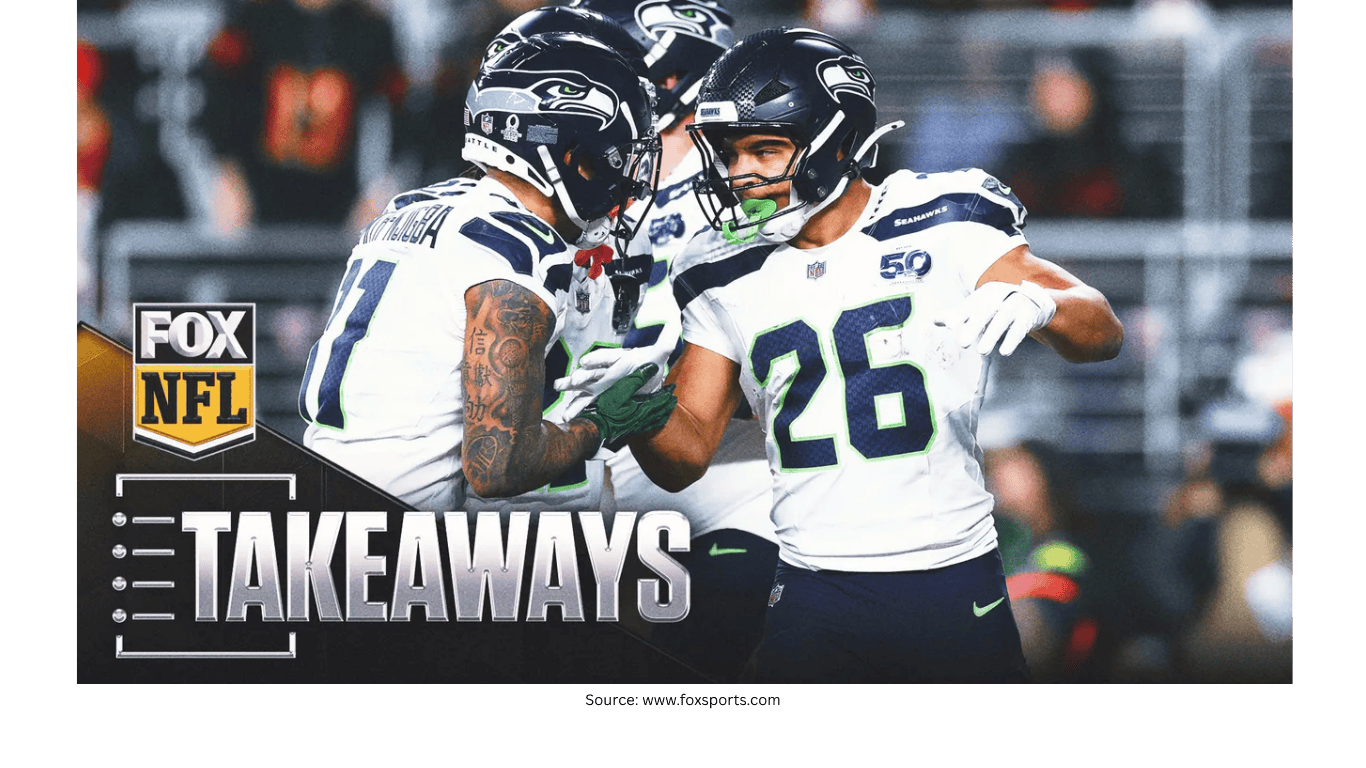
Seattle locks up the No. 1 seed—and adds a milestone season
Seattle’s 13–3 victory over San Francisco at Levi’s Stadium carried major postseason implications. With the win, the Seahawks clinched the NFC West and secured home-field advantage throughout the NFC playoffs as the conference’s No. 1 seed. It also marked the first 14-win season in franchise history and the fourth time the Seahawks have earned the top seed in the NFC.
The result also arrived in a setting that underscored how well both teams were playing entering the finale. According to the Elias Sports Bureau, Seahawks-49ers was the first regular-season finale in league history in which both teams entered on six-game winning streaks. San Francisco finished the regular season 12–5 and, with the loss, faced a more complicated path into the postseason.
Historically, Seattle’s previous No. 1 seed seasons have been associated with deep playoff runs. The last three times the Seahawks held the top seed, they went on to reach the Super Bowl. While that history doesn’t guarantee anything, it frames how meaningful the achievement is for a team that now gets extra rest and will host a to-be-determined opponent in the NFC Divisional Round.
Takeaway 1: Sam Darnold delivered the steady, mistake-free game Seattle needed
In a matchup with the division title and the No. 1 seed on the line, Seattle’s approach leaned heavily on efficiency and ball security. Sam Darnold finished 20-of-26 for 198 yards, without a touchdown. The more important detail for Seattle’s formula was that he did not turn the ball over.
That mattered in context. Darnold had 20 turnovers on the season, and his recent history included a difficult finish to the previous year, when he struggled in the final two games for Minnesota. In those two contests, he completed 53% of his passes for a combined 411 yards with one touchdown and two total turnovers, was sacked 11 times, and posted a 66.4 passer rating.
Seattle’s locker room support for Darnold has been a recurring theme, and this game gave him a chance to return that trust in the most practical way possible: by avoiding the mistake that could swing a low-scoring contest. Even a fumbled handoff exchange with Zach Charbonnet did not turn into a turnover, as Darnold recovered it. In a game where points were at a premium, that kind of composure helped Seattle secure the division and a first-round bye.
Takeaway 2: The Seahawks’ rushing attack controlled the game from the start
Seattle’s most consistent offensive advantage came on the ground. The Seahawks “gashed” San Francisco’s defense early and kept it going through the final whistle, finishing with 180 rushing yards. That production stood out because the 49ers entered the game allowing just 103 rushing yards per contest, ranking No. 6 in the NFL. Yet Seattle had already piled up 115 rushing yards by halftime, setting the tone for a game plan built around tempo and possession.
Ken Walker led the way with 97 rushing yards, while Zach Charbonnet added 74 yards and scored the game’s lone touchdown. Beyond the raw totals, the rushing success helped Seattle control the clock and limit how many opportunities San Francisco’s offense had to find rhythm.
That possession advantage became even more significant considering how productive the 49ers had been during their winning streak. Over their six consecutive victories, San Francisco averaged 36 points per game. In this matchup, Seattle’s ability to keep the ball and stay committed to the run helped hold the 49ers to just three points.
Takeaway 3: Seattle’s defense contained the 49ers’ biggest threats
Seattle’s defense delivered a performance built on tackling, discipline, and timely plays. A key storyline was the way the Seahawks limited Christian McCaffrey, who entered the game with 2,069 scrimmage yards and 17 touchdowns. McCaffrey had joined LaDainian Tomlinson as the only players in NFL history with three seasons of at least 2,000 scrimmage yards and 15 touchdowns—numbers that illustrate how difficult he can be to contain.
On Saturday night, Seattle held McCaffrey to 23 rushing yards and 57 total scrimmage yards. The 49ers struggled to create space in the run game, and they also did not consistently spring McCaffrey in the passing game.
The defining defensive moment came late, when McCaffrey dropped a pass near the end zone. Seattle linebacker Drake Thomas turned that sequence into a crucial interception, ending a fourth-quarter drive in the red zone. Seattle also limited Brock Purdy, who had guided the 49ers to a 6–0 record since returning from a turf toe injury. Purdy finished with 127 passing yards, no touchdowns, and one interception, producing a 64.9 passer rating.
Takeaway 4: Special teams were uneven, but the margin held
Even in a win, Seattle had special-teams moments it will want to clean up before the postseason. Kicker Jason Myers, regarded as one of the league’s best, missed field-goal attempts from 47 and 26 yards. He also kicked the ball out of bounds on a kickoff, giving San Francisco the ball at the 40-yard line.
Myers had made 18 straight field goals entering the game, so the misses stood out as an exception to his recent form. With Seattle now headed home to the Pacific Northwest for rest before the Divisional Round, the team will have time to reset and prepare for a higher-stakes environment where every point can matter.
What the result means for both teams
Seattle’s path is clear: a first-round bye and a home game in the NFC Divisional Round against an opponent to be determined. San Francisco, meanwhile, heads into the postseason as a road team. The 49ers’ seed is tied to the result of the Rams-Cardinals game. If the Rams win, San Francisco becomes the No. 6 seed and would go on the road against either the Bears or Eagles. If the Rams lose, San Francisco would face the winner of the NFC South.
In a rivalry where San Francisco had won seven of the previous eight meetings, Seattle’s 13–3 win not only flipped recent momentum but also delivered the most valuable reward available in the NFC: the No. 1 seed and home-field advantage throughout the conference playoffs.