
Four Takeaways From the Patriots’ Wild-Card Win Over the Chargers
A playoff return that looked like a statement
The Patriots entered Sunday night with a sense of transition and opportunity. It was their first playoff game in three years, and it came with the possibility of signaling a new era led by a new quarterback. By the end of a tense, defense-driven contest at Gillette Stadium, New England had done more than simply survive: it had earned a 16-3 wild-card victory over the Los Angeles Chargers and moved on to the Divisional Round.
The shape of the game mattered as much as the result. New England finished on a 13-0 run, turning an early, tight matchup into a controlled finish. The win also carried historical weight for the franchise, as the Patriots advanced to the Divisional Round for the first time since the 2018 season, the same season in which they last won the Super Bowl.
From the outside, a 16-3 final score can suggest a one-sided night. In reality, the game’s story was more layered: the Patriots’ defense repeatedly shut doors on scoring chances, the Chargers’ defensive front created problems and turnovers without converting them into points, and quarterback Drake Maye had to win in a way that didn’t always resemble a typical quarterback showcase. The following four takeaways capture how the Patriots advanced and why the Chargers were left with so many unresolved questions.
1) New England’s defense controlled the game even without a flurry of takeaways
The Patriots’ defense recorded only one takeaway, but the overall performance was dominant. The most important part of that dominance was how consistently New England removed the Chargers’ options, particularly in the passing game. Star cornerback Christian Gonzalez and the rest of the secondary were described as “sticky in coverage,” and that tight coverage erased downfield opportunities for Justin Herbert.
Herbert finished with just 159 passing yards, a number that reflected more than conservative play-calling. New England’s ability to cover and pressure at the same time made the Chargers’ passing game feel constrained. The Patriots overwhelmed Los Angeles’ offensive line—an area that has been criticized—using stunts and pressure packages that consistently disrupted timing. Herbert was sacked six times and took 11 hits overall, with pressure and contact coming from seven different Patriots defenders.
The defensive success showed up most clearly in the moments when the Chargers were closest to turning the game. Los Angeles got inside the New England three-yard line twice in its first three drives, yet came away with only three points. That kind of red-zone resistance is often the difference between a game that stays within reach and one that slips away. When an offense repeatedly reaches scoring range and fails to capitalize, the burden increases on every subsequent possession.
New England also won the “down-to-down” battle. The Chargers were held to 1-of-10 on third down, a statistic that illustrates how hard it was for Los Angeles to sustain drives. Even when the Chargers found a first down or two, they rarely found a rhythm that could carry them across multiple series. The Patriots’ defense did not need a string of interceptions to dominate; it simply needed to win snaps, tighten windows, and keep Herbert under pressure.
Context from the regular season supports the idea that this was not a one-night outlier. New England ranked fourth in points allowed and eighth in total defense during the regular season. Around the league, defenses from the Texans, Seahawks, and Broncos have been among the most discussed this season. The Patriots’ unit belongs in that conversation as well, and this playoff performance served as a clear example of a defense capable of playing at a championship level.
2) The Chargers’ defensive line created real disruption—and two turnovers—but couldn’t change the scoreboard
The final score will naturally place the spotlight on New England’s defense, but the Chargers’ defensive front also had a major impact on how the game unfolded. Even in a losing effort, Los Angeles consistently pressured Drake Maye and forced mistakes that could have shifted momentum if they had been converted into points.
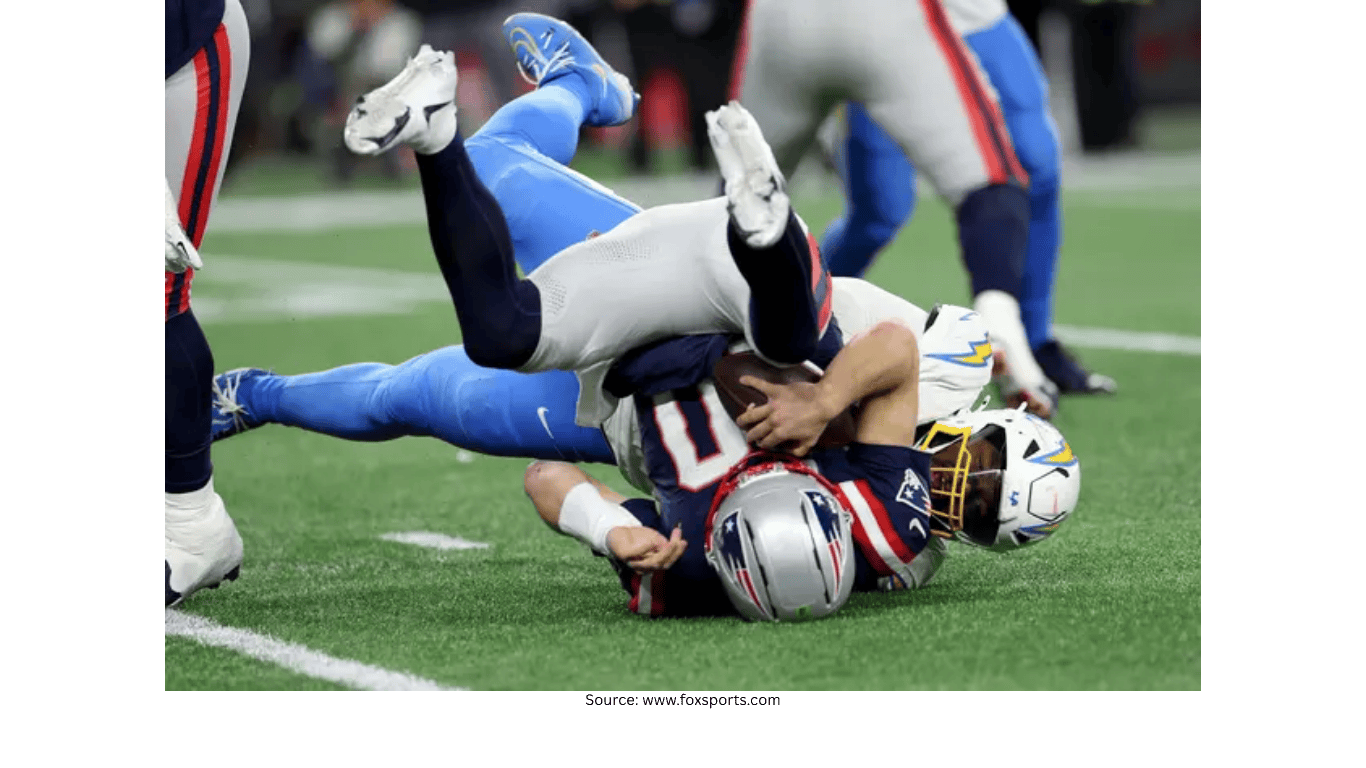
Two plays in particular defined the Chargers’ success up front. In the first quarter, nose tackle Teair Tart batted a pass at the line of scrimmage, and the deflection led to an interception by linebacker Daiyan Henley. Later, in the fourth quarter, edge rusher Odafe Oweh stripped Maye, creating a fumble that was recovered by defensive end Da’Shawn Hand.
Those takeaways did not result in points, but they did slow down New England’s offense. That detail matters: turnovers are often discussed as automatic game-changers, yet their true value depends on what follows. In this case, the Chargers’ defense created opportunities but did not cash them in, and the Patriots ultimately absorbed the damage.
Beyond the turnovers, the pressure was constant. Los Angeles sacked Maye five times, registered seven tackles for loss, and forced two fumbles (one of which New England recovered). Maye was repeatedly made to move, reset, or protect the ball rather than operate comfortably. The cumulative effect was a game in which New England had to win with patience and situational execution rather than offensive flow.
For the Chargers, the defensive front’s performance was one of the few areas that consistently held up under playoff intensity. It also underscored a frustrating theme of the night: Los Angeles had moments that should have created leverage—pressure, sacks, takeaways, and early trips inside the three-yard line—yet the team never turned those moments into sustained advantage on the scoreboard.
3) Drake Maye’s legs were the difference in a low-scoring playoff game
Drake Maye is often praised for having arguably the NFL’s best deep ball, but in this particular matchup it was his mobility that proved most decisive. In a game where passing lanes were contested and pressure arrived quickly, Maye’s ability to create with his legs became a practical solution to the Chargers’ defensive approach.
Maye finished with 10 carries for 66 yards, and the timing of those runs mattered. His most notable scramble was a 37-yard run late in the second quarter that set up New England’s go-ahead field goal. In a low-scoring game, a single explosive play that flips field position can function like a drive all by itself, and that scramble helped New England take control of the game before halftime.
His mobility also played a role in the fourth quarter sequence that produced the game’s only touchdown. Maye had an eight-yard run that created a second-and-short situation, and that manageable down and distance helped set up the scoring play: a Maye touchdown pass to tight end Hunter Henry. When defenses know a quarterback can run, it changes how they defend short-yardage situations, and Maye used that dynamic at a critical moment.
Maye’s rushing production aligns with what he has shown over the course of the season. During the regular season, he had the second-most total scramble yards (706), according to Next Gen Stats. That background makes his impact on the ground less surprising, but it still stood out in a playoff setting where every yard is contested.
Because of the Chargers’ persistent pressure, Maye’s overall numbers were not described as his most impressive. He was forced into two turnovers and took multiple sacks. Still, he delivered when the game demanded it, particularly late. In the second half, he completed 11-of-14 passes for 173 yards and a touchdown. The combination of timely passing, situational rushing, and late-game composure was enough to win, even if the night did not resemble a clean statistical showcase.
4) Justin Herbert’s playoff narrative grows louder after another difficult night
For Justin Herbert, the conversation entering 2025 has been shaped by a familiar critique: that he does not deliver in the playoffs, despite being viewed as a supremely talented quarterback capable of producing big regular-season numbers. Prior to Sunday night, Herbert was 0-2 in his first two playoff games, completing 52.0% of his passes for two touchdowns and four interceptions with a 60.7 passer rating.
This performance is likely to add fuel to that perception. Herbert struggled to push the ball downfield, and the Patriots’ defense deserves significant credit for that. New England’s secondary was described as terrific, and the coverage consistently reduced the available windows. At the same time, the Chargers’ offensive line and receivers did not help, and the overall offensive structure never found stability.
Still, the expectations attached to a top franchise quarterback are not limited to favorable conditions. In games like this, observers often look for a player who can “put the offense (and team) on his back.” On Sunday night, Herbert was unable to do that. He completed 61.3% of his passes for just 159 yards, with no touchdowns and a lost fumble. Those numbers, paired with the offense’s inability to convert early red-zone chances and third downs, left Los Angeles without a path back into the game once New England began to pull away.
The result was a night in which the Chargers had too many empty possessions and too few answers. The Patriots’ defense made the task difficult, but the Chargers also failed to create solutions when the initial plan stalled. In the postseason, that combination tends to be decisive.
What comes next
With the win, the Patriots move forward and will play the winner of Texans vs. Steelers in the Divisional Round. That game will be next Sunday in Foxborough. New England’s path ahead will not get easier, but the formula that won this wild-card matchup—defense that dictates terms, an offense that can survive pressure, and a quarterback who can create in key moments—travels well in January.
The Chargers, meanwhile, leave the playoffs with a performance that was competitive in flashes but ultimately defined by missed opportunities: early drives that reached the doorstep of the end zone and produced only three points, takeaways that did not translate into scoring, and an offense that could not sustain drives against a defense that consistently won the most important downs.
Key game notes at a glance
Final score: Patriots 16, Chargers 3; New England finished the game on a 13-0 run.
Patriots defense: Herbert held to 159 passing yards; six sacks and 11 total hits; Chargers 1-of-10 on third down.
Chargers defense: pressured Maye into two turnovers; five sacks; seven tackles for loss; two forced fumbles (one recovered by New England).
Drake Maye’s impact: 10 carries for 66 yards, including a 37-yard scramble that set up a go-ahead field goal; second-half passing line of 11-of-14 for 173 yards and a TD.
Scoring highlight: the game’s only touchdown was a Maye pass to tight end Hunter Henry.
In the end, the Patriots did not need a high-powered offensive display to advance. They needed timely plays, strong coverage, and a quarterback who could find yards when the structure of the play broke down. Against a Chargers team that could not turn pressure and field position into points, that was enough to keep New England’s postseason moving.